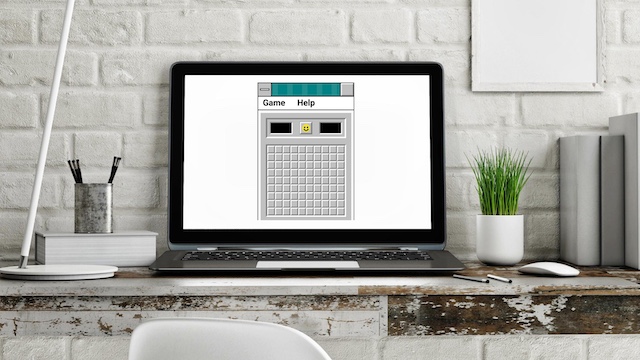
You play Minesweeper by clearing every safe square on a grid without clicking a mine. When you reveal a square, it shows a number that tells you how many mines touch it (including diagonals). Use those numbers to deduce where mines are, flag them, and keep revealing safe squares until the board is cleared.
If you’ve ever lost on your second click and questioned your life choices, welcome. The rules are simple. The grid is not.
What You Need to Play
- Any Minesweeper version (Windows, web, mobile, or app)
- A mouse or touchscreen
- Optional but recommended: patience and the ability to admit you miscounted diagonals
Setup
- Choose a difficulty (names vary by version):
- Beginner / Easy: smaller grid, fewer mines
- Intermediate / Medium: mid-sized grid
- Expert / Hard: large grid, many mines
- Start a new game. You’ll see a grid of covered squares.
- Know your controls (most versions):
- Left-click / tap: reveal a square
- Right-click / long-press: flag/unflag a mine
- Some versions add question marks as a third state (flag, ?, blank)
This is where many players get confused: flags don’t do anything automatically. They’re your note-taking system. Minesweeper will not “save you” from clicking a mine you didn’t flag.
How to Play (Numbered Steps)
- Reveal your first square.
This opens space and gives you numbers to work with. Many modern versions guarantee the first click is safe. - Read the number clues.
A revealed square shows:- 0 (blank): no mines touch it, and it usually auto-reveals nearby squares
- 1–8: the count of mines in the eight surrounding squares (up, down, left, right, and diagonals)
- Mark mines with flags when you’re certain.
If a numbered square has exactly that many hidden squares adjacent to it, those hidden squares are mines. Flag them. - Reveal safe squares you can prove are safe.
If a numbered square already has the correct number of adjacent flagged mines, then all other adjacent hidden squares are safe to click. - Repeat deduction across the board.
You’ll bounce between:- flagging guaranteed mines
- clicking guaranteed safe squares
- using multiple numbers together to solve tighter areas
- Win by clearing all non-mine squares.
Depending on the version, you win when:- every safe square is revealed, or
- every mine is flagged (less common), or
- the game auto-flags remaining mines when you clear all safe squares
How the Game Ends
- You lose immediately when you reveal a mine.
- You win when all safe squares are revealed (the main win condition).
How to Win
To win consistently, follow one principle: only click squares that the numbers prove are safe. Minesweeper is a logic game first. A panic-click game second.
Strategy Tips
- Start in open areas. Corners often reveal less information early.
- Use the “all mines” and “all safe” rules constantly:
- If a “1” touches one hidden square, that hidden square is a mine.
- If a “2” already has two flagged mines touching it, the other adjacent hidden squares are safe.
- Think in sets, not single numbers. The strongest plays come from comparing neighboring numbers.
- Avoid flag-spam. Flags are helpful, but over-flagging guesses creates fake certainty and kills runs.
- Learn common patterns (these show up constantly):
- 1–1 on an edge often creates a forced mine placement
- 1–2–1 lines frequently indicate mines on the ends
- 2–3–2 patterns usually mean a tight cluster you can deduce without guessing
Common Mistakes
- Forgetting diagonals count. The number includes all eight neighboring squares, not just the four sides.
- Assuming the game reads your mind. A flag doesn’t prevent you from clicking a mine somewhere else.
- Guessing too early. Most boards give solvable information if you expand elsewhere first.
- Miscounting flagged mines. One incorrect flag poisons every deduction around it.
- Ignoring edges. Edges and corners reduce possibilities and often become solvable sooner than you think.
Quick Reference Summary
- Goal: reveal all safe squares without clicking mines.
- Numbers show how many mines touch that square (including diagonals).
- Flag squares that must be mines.
- If a number already has that many flags nearby, the other adjacent squares are safe.
- Win when all non-mine squares are revealed.
Keep the Game Going!
Now that you know how Minesweeper works, all that’s left to do is open the game and start clearing the grid. With a little practice, you’ll start spotting patterns, placing flags confidently, and avoiding those hidden mines like a pro.
If you enjoy quick puzzle-style games like this one, explore more of our computer game how-to articles.
Frequently Asked Questions
Is Minesweeper always solvable without guessing?
Not always. Some versions generate boards that can force a 50/50 guess late-game. Other versions try to ensure solvable layouts. If you’re stuck, expand another area first before committing to a guess.
Should I flag every mine?
Flagging helps prevent mistakes and supports deductions, but you don’t need to flag everything to win in many versions. What matters is revealing all safe squares.
What does a blank square mean?
A blank (0) means no mines touch it, and it usually auto-reveals a region of nearby safe squares until numbers appear.