Shuffleboard is one of those games that looks effortless until your first shot rockets off the table like it’s late for a meeting. The good news: the rules are simple, and you can learn them in about the time it takes your friend to say, “That totally would’ve scored if the table wasn’t weird.”
At its core, shuffleboard is all about sliding discs (called weights) into scoring zones while using smart bumps and blocks to ruin your opponent’s day in a polite, socially acceptable way. Most games are played to 15 points on a table (often in bars), or a higher total on a court version, and scoring typically happens after all discs are played for the round.
People often mix up the two main versions, so this guide covers table shuffleboard and deck shuffleboard clearly, with setup, scoring, and the stuff that usually starts debates mid-game.
What You Need to Play
Table Shuffleboard
- A shuffleboard table (usually 9–22 feet)
- 8 discs/weights (typically 4 per player/team)
- Shuffleboard wax/sand (often called “shuffleboard powder”)
Deck Shuffleboard
- A shuffleboard court (taped or painted)
- 8 discs (often plastic with metal rims)
- 2 cues (sticks) for pushing discs
- A scoreboard or paper to track points
Setup
Table Shuffleboard Setup
- Decide singles (1v1) or doubles (2v2).
- Each side gets 4 weights (often colored).
- Choose the winning score, commonly:
- 15 points (bar standard)
- 21 points (also common)
Deck Shuffleboard Setup
- Pick teams and assign colors.
- Decide winning score, commonly 75 points in traditional league play, but casual games often use 50 or 100.
- Confirm the court layout:
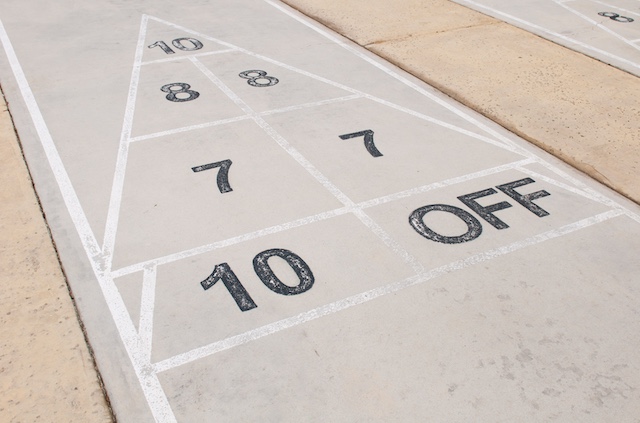
- Scoring triangles typically show 10, 8, 7 (and sometimes special zones like “10-off”)
- Determine who shoots first (coin flip or closest-to-line practice shot).
This is where many players get confused: table shuffleboard scoring zones are usually lines, while deck shuffleboard uses numbered triangles. Same vibe, different geometry.
How to Play (Numbered Steps)
Table Shuffleboard (Bar/Table Version)
- Start at one end of the table.
Players shoot toward the scoring end. - Alternate shots.
Players take turns sliding one weight at a time until all 8 weights are played. - Slide the weight with your hand.
You must release it before the foul line (house rules vary, but don’t “carry” it halfway down). - Try to land in scoring zones.
Most tables have zones worth 1, 2, and 3 points (some have 4). - Use strategy shots.
You can:- Knock your opponent’s weight off the table
- Bump your own weight into a better zone
- Block lanes so they can’t land cleanly
- Score only after all weights are thrown.
Only the weights past the “score line” count (depending on table markings). - “Only one side scores” (traditional rule).
Compare your scoring weights to your opponent’s:- Only the team with the single best-positioned weight scores for that round
- Count only weights that are closer than the opponent’s closest scoring weight
- First to the target score wins (often 15 or 21).
Table Shuffleboard Scoring (Typical)
- 3 points: farthest zone
- 2 points: middle zone
- 1 point: nearest scoring zone
- 0 points: not fully over the scoring line, or off the table
Deck Shuffleboard (Court Version)
- Teams stand behind the baseline.
You shoot from one end toward the scoring triangles on the opposite end. - Alternate turns pushing discs with a cue.
Each team plays one disc at a time until all 8 are played. - Discs must stay within the court.
Discs that go out are removed (and usually count as 0). - Aim for high-scoring zones.
Common zones include 7, 8, and 10. - Watch for “10-off” if your court has it.
Some courts have a -10 zone (often to punish reckless shots). - Score after all discs are played.
Like table shuffleboard, most rules use “only one side scores” each end, based on whose discs are best positioned. - Repeat ends until someone reaches the winning score.
Deck Shuffleboard Scoring (Typical)
- Add up your scoring discs that are:
- Completely inside a scoring zone (rules vary on “line counts”)
- Not beaten by an opponent disc closer to the top of scoring priority
- If your court includes “10-off,” subtract points for discs landing there
How the Game Ends
- Table shuffleboard usually ends when a player/team reaches 15 or 21 points.
- Deck shuffleboard often ends at 50, 75, or 100 points, depending on how serious everyone is pretending to be.
How to Win
You win by reaching the target score first, but the real secret is this:
- Don’t just aim for points. Aim to deny points.
A “boring” blocker weight that ruins an opponent’s perfect lane can be worth more than a flashy long shot.
Strategy Tips
Table Shuffleboard Tips
- Weight control beats power. Soft shots that “stick” are gold.
- Use a guard. Leave a weight short as a blocker to protect your scoring disc.
- Bump, don’t pray. If you’re off target, a gentle bump shot can fix it.
- Steal points with last shot advantage. Shooting last in a round is huge.
Deck Shuffleboard Tips
- Play defense early. A well-placed disc can block access to the 10 zone.
- Knockouts are your friend. Removing opponent discs is often better than chasing a risky 10.
- Avoid “10-off.” If your court has it, treat it like lava.
- Master the “kitchen.” (Some courts have non-scoring areas that still matter for positioning.)
Common Mistakes
- Scoring mid-round. Shuffleboard is scored after all discs are played.
- Assuming both teams score every round. Many rule sets use only one side scores per end.
- Not agreeing on “line rules.” Whether a disc touching a line counts can change everything.
- Overpowering shots. Especially on table shuffleboard, too much force equals “nice try” followed by “now it’s off the table.”
- Ignoring defense. If you only chase high zones, you’ll lose to someone who blocks and bumps.
Quick Reference Summary
- Slide/push discs toward scoring zones.
- Players alternate shots until all discs are played.
- Score after all discs are thrown.
- Often only one side scores per round, based on best disc positions.
- First to the agreed score wins (table: usually 15/21; deck: often 50/75/100).
More to Explore Outdoors
Now that you know how to play shuffleboard, you’re ready to step up, take your shot, and see how quickly a casual round can turn competitive. It’s one of those classic outdoor games that’s simple to start and fun to keep coming back to.
For more easy-to-follow guides like this one, explore our other outdoor games articles and find your next favorite game.