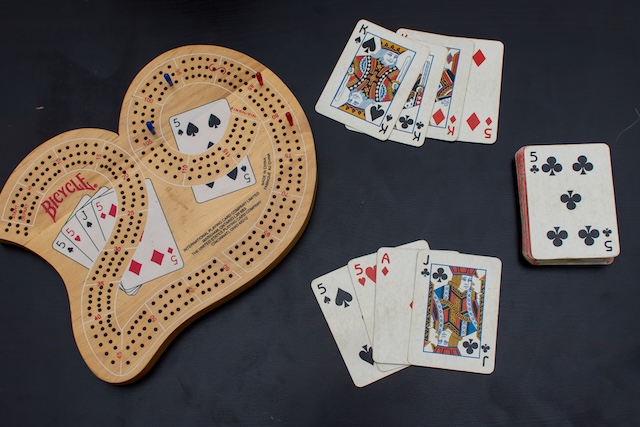
Cribbage is a card game in which players score points by creating combinations of cards, including pairs, runs, flushes, and combinations totaling 15. The standard game is played by two people using a 52-card deck and a cribbage board to keep score.
The goal of cribbage is to be the first player to reach 121 points. Points are earned during several parts of each hand: while players take turns laying down cards and when each player counts the combinations in their completed hand.
Cribbage can seem complicated at first because scoring happens in more than one way. Once you understand the basic sequence of deal, discard, play, and count, the game becomes much easier to follow.
What You Need to Play Cribbage
For a standard two-player game of cribbage, you need:
- A standard 52-card deck with the jokers removed
- A cribbage board
- Two pegs for each player
The cribbage board is used only to track the score. Players move their pegs along the board as they earn points.
If you don’t have a cribbage board, you can still play by keeping a written score, although using the board makes scoring easier.
What Is the Goal of Cribbage?
The goal of cribbage is to be the first player to score 121 points.
Players move their pegs around the cribbage board as they score. Each player uses two pegs so the previous score remains visible while the second peg is moved to the new total.
A player can reach 121 points during any scoring portion of the game. The game ends immediately when someone reaches the winning score. You do not need to finish the hand.
Card Values in Cribbage
Card values are important when determining whether cards total 15 or whether the running total during play has reached 31.
Aces are worth 1 point. Cards 2 through 10 are worth their face value. Jacks, queens, and kings are each worth 10.
These numerical values are separate from the points awarded for pairs, runs, flushes, and other scoring combinations.
How to Set Up Cribbage
Each player places two pegs in the starting position on the cribbage board.
The players then determine who deals first. One common method is for each player to cut a card from the deck. The player who draws the lower card deals first.
After the first hand, players alternate dealing.
The dealer shuffles the deck, and the non-dealer cuts it. The dealer then deals six cards to each player, one card at a time.
How to Play Cribbage Step by Step
A cribbage hand has several distinct stages. Players receive their cards, choose cards for the crib, play cards to a running total, and then score their hands.
Choose cards for the crib
After receiving six cards, each player chooses two cards and places them face down in a separate pile called the crib.
Each player is left with four cards in their regular hand.
The four discarded cards form the crib, which belongs to the dealer. The dealer will score the crib after both players’ regular hands have been counted.
This creates an important strategic difference between the dealer and non-dealer. When you are the dealer, you generally want to place potentially useful cards in the crib. When your opponent is the dealer, you generally want to avoid giving the crib cards that are likely to score well together.
Turn over the starter card
Once both players have discarded two cards into the crib, the non-dealer cuts the remaining deck. The dealer turns over the top card of the lower portion.
This card is called the starter, cut card, or upcard.
The starter is not played during the next phase. Instead, it becomes a fifth card used when each player scores their hand and when the dealer scores the crib.
If the starter card is a jack, the dealer immediately scores 2 points. This is traditionally called “his heels” or “his nibs.”
Play the cards
The non-dealer plays one card face up and announces its value. The dealer then plays a card and announces the new running total.
Players continue alternating.
For example, if the first player lays down a 7, the total is 7. If the next player lays down a 6, the running total becomes 13. If the next card is a 10, the total becomes 23.
The running total cannot exceed 31.
Players can earn points during this phase by reaching certain totals or creating combinations with consecutively played cards.
Say “go” when you cannot play
If you cannot play a card without making the running total exceed 31, you say “go.”
The other player continues playing any cards they can without exceeding 31.
When neither player can play another card, the player who played the last card scores 1 point for the last card, unless that card made the total exactly 31. Reaching exactly 31 is worth 2 points.
The count then resets to zero, and play continues with the remaining cards.
This continues until both players have played all four cards.
How Does Scoring Work in Cribbage?
One of the most important parts of learning how to play cribbage is understanding that points can be scored both during the play and when the completed hands are counted.
Scoring during play
During the play, also known as pegging, players can score for the following:
| Play | Points |
|---|---|
| Total of 15 | 2 |
| Total of 31 | 2 |
| Pair | 2 |
| Three of a kind | 6 |
| Four of a kind | 12 |
| Run of three or more | 1 point per card |
| Last card without reaching 31 | 1 |
A pair occurs when you play a card of the same rank as the card immediately before it.
For example, if your opponent plays an 8 and you play another 8, you score 2 points.
If three cards of the same rank are played consecutively, the player who places the third card scores 6 points. Four consecutive cards of the same rank score 12 points.
Runs can also score during play. If the most recently played cards can be arranged into consecutive rank order, they can form a run even if they were not played in numerical order.
For example, cards played as 5, 7, 6 form a three-card run, so the player who lays down the 6 scores 3 points.
How to Count a Cribbage Hand
After all the cards have been played, players score their hands.
The non-dealer counts first. The dealer counts second, followed by the dealer’s crib.
Each four-card hand is combined with the starter card, giving the player five cards to use for scoring.
Cards can contribute to more than one scoring combination.
Fifteens
Every distinct combination of cards that totals exactly 15 scores 2 points.
For example, a 7 and an 8 make 15 and score 2 points. A 2, 3, and 10 also total 15 and score another 2 points.
If your five cards contain several different combinations that equal 15, you score each combination separately.
Pairs
Two cards of the same rank score 2 points.
Three cards of the same rank contain three different pairs and therefore score 6 points.
Four cards of the same rank contain six different pairs and score 12 points.
Runs
A sequence of three or more consecutive ranks scores one point for each card in the run.
For example:
4, 5, 6 = 3 points
8, 9, 10, J = 4 points
10, J, Q, K = 4 points
Suits do not matter when scoring runs.
Aces are low in cribbage, so A-2-3 is a valid run. An ace cannot be used above a king.
Hands containing duplicated ranks can also produce multiple runs, which means some hands score more than the length of a single sequence might initially suggest.
Flushes
A flush in a regular cribbage hand scores 4 points when all four cards in the player’s hand have the same suit.
If the starter is also the same suit, the flush scores 5 points.
The crib follows a stricter rule: a flush in the crib scores only if all four crib cards and the starter are the same suit. A four-card flush in the crib does not score.
His nobs
If your four-card hand contains a jack of the same suit as the starter card, you score 1 point.
This is commonly called “his nobs” or “nobs.”
Do not confuse this with the dealer’s 2 points for turning over a jack as the starter.
What Is the Crib in Cribbage?
The crib is a separate four-card hand created from the cards discarded by both players at the beginning of the round.
It always belongs to the dealer.
After the non-dealer scores their hand and the dealer scores their own hand, the dealer combines the four crib cards with the starter and scores the crib.
The crib can score fifteens, pairs, runs, flushes, and nobs just like a regular hand, although the flush rule is different.
Because only the dealer scores the crib, deciding which two cards to discard is an important part of cribbage strategy.
Example of a Cribbage Round
Suppose you are dealt six cards. You choose the four cards you want to keep and place the other two in the crib. Your opponent does the same.
The starter card is then revealed.
You and your opponent take turns playing your four cards while keeping the running total at 31 or lower. During this phase, you immediately peg any points earned for reaching 15 or 31, making pairs, or creating runs.
After all eight cards have been played, the non-dealer scores their four-card hand using the starter as a fifth card.
The dealer then scores their hand using the same starter.
Finally, the dealer scores the four cards in the crib, again using the starter as the fifth card.
The deal switches to the other player, and a new hand begins.
Who Scores First in Cribbage?
The non-dealer always counts their hand first.
The scoring order after the play is:
Non-dealer’s hand → Dealer’s hand → Dealer’s crib
This order matters because the game ends as soon as someone reaches 121 points.
For example, if both players are close to 121, the non-dealer could win while counting their hand before the dealer gets an opportunity to count a higher-scoring hand or crib.
How Do You Use a Cribbage Board?
A standard cribbage board contains tracks of holes that allow players to record their progress toward 121 points.
Each player uses two pegs.
When you score points, move the peg that is farther behind past the other peg by the number of points scored. The stationary peg records your previous score, while the moved peg shows your new score.
This alternating, leapfrog-style movement makes it easier to verify how many points were just scored.
What Is a Perfect Hand in Cribbage?
The highest possible cribbage hand is worth 29 points.
A 29-point hand consists of three 5s and a jack in your hand, with the fourth 5 appearing as the starter. The jack must be the same suit as the starter 5.
The hand scores through multiple combinations of 15, pairs among the four 5s, and the 1-point nobs bonus.
A 29-point hand is extremely rare.
Basic Cribbage Strategy for Beginners
You do not need to master advanced strategy before playing your first game, but a few basic principles can improve your decisions.
Look for combinations that make 15
Because every combination totaling 15 earns 2 points when hands are counted, cards that work together to make 15 can be valuable.
Fives are especially useful because every 10, jack, queen, and king can combine with a 5 to make 15.
Keep pairs and connected cards
Pairs guarantee scoring opportunities when the hand is counted, while cards close together in rank may form runs depending on the starter.
For example, keeping 4, 5, and 6 together already gives you a three-card run.
Be careful what you give your opponent’s crib
When your opponent is dealing, avoid discarding combinations that work especially well together when possible.
A pair of 5s, for example, can be particularly valuable in a crib because so many starter cards can contribute to combinations totaling 15.
Think about the running total
During pegging, do not consider only the points you can score immediately. Think about what total you leave for your opponent.
Leaving an opponent an easy opportunity to reach 15 or 31 may give away points.
Common Cribbage Terms to Know
Crib: The four-card bonus hand belonging to the dealer.
Starter: The card revealed after players discard to the crib. It is used when scoring both hands and the crib.
Pegging: The portion of the game in which players alternate playing cards while keeping a running total no higher than 31.
Go: What a player says when they cannot legally play another card without exceeding 31.
Nobs: One point awarded for holding a jack of the same suit as the starter.
Heels: Two points awarded to the dealer when the starter itself is a jack.
Fifteen: A combination of cards totaling 15, worth 2 points.
Thirty-one: Reaching a running total of exactly 31 during pegging, worth 2 points.
Frequently Asked Questions About Cribbage
How many cards do you get in cribbage?
In a standard two-player game, each player is dealt six cards. Each player then places two cards into the crib, leaving four cards to play and score.
How many points do you need to win cribbage?
A standard game of cribbage is played to 121 points. The first player to reach 121 wins immediately.
Can you go over 31 in cribbage?
No. During pegging, you cannot play a card that would make the running total exceed 31. If you cannot legally play a card, you say “go.”
What happens when you get exactly 15?
If you make the running total exactly 15 during pegging, you score 2 points.
Combinations totaling 15 also score 2 points each when hands and the crib are counted.
What happens when you get exactly 31?
Reaching exactly 31 during pegging scores 2 points. The running count then resets, and play continues with any remaining cards.
Do suits matter in cribbage?
Usually, card rank and value are more important than suit. Suits matter when scoring flushes and nobs.
Does the ace count as 1 or 11 in cribbage?
An ace is always worth 1 in cribbage. It is also treated as the lowest-ranking card when making runs.
Who gets the crib?
The dealer gets the crib. Because players alternate dealing after every hand, they also alternate who receives the crib.
Who plays first in cribbage?
The non-dealer plays the first card during pegging. The non-dealer also counts their completed hand before the dealer.
Can you play cribbage without a cribbage board?
Yes. The board is a scoring device rather than a requirement for playing the card game. You can keep score with paper or another method as long as both players can accurately track their points.
How to Remember the Order of Play
For beginners, the easiest way to learn cribbage is to remember four stages:
Deal → Discard → Play → Count
Deal six cards to each player.
Discard two cards from each hand to create the crib.
Play the remaining cards while keeping a running total no higher than 31.
Count the non-dealer’s hand, the dealer’s hand, and finally the crib.
Then switch dealers and repeat the process until one player reaches 121 points.
Enjoy Your Next Game of Cribbage!
Cribbage combines card combinations, strategy, and a distinctive scoring system. In a standard two-player game, each player receives six cards, discards two to the dealer’s crib, and plays the remaining four while trying to score points. After the play, both hands and the crib are counted using the starter card.
The first player to reach 121 points wins.
The scoring system may take a few hands to become familiar, but the basic flow is straightforward once you remember the four main stages: deal, discard, play, and count.