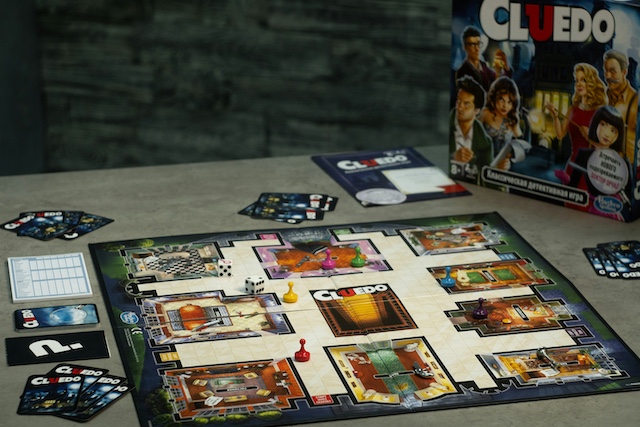
Clue is the classic “who did it, where, and with what” mystery game, where everyone acts innocent while quietly hoarding information. Your job is to turn a few polite questions into a full-on, airtight accusation before anyone else does.
What You Need to Play
- Clue/Cluedo board
- 6 suspect pawns (characters)
- 6 weapon tokens (varies by edition)
- Room cards, Suspect cards, Weapon cards
- Envelope (Case File)
- Notepad (or your own detective notes)
- 2 dice
Affiliate-friendly note: if someone’s copy is missing pieces (it happens), replacement dice and a small card organizer/holder can make setup less chaotic.
Setup
- Place the board in the center of the table.
- Put each weapon token in any room (some editions suggest starting rooms, but it doesn’t affect fairness).
- Sort cards into three piles: Suspects, Weapons, Rooms.
- Create the Case File:
- Shuffle each pile separately.
- Randomly draw 1 Suspect, 1 Weapon, 1 Room and place them face-down in the envelope without looking.
- This envelope is the true solution.
- Shuffle all remaining cards together and deal them out face-down to players as evenly as possible.
- If a few extra cards remain (depends on player count/edition), deal them one at a time until they’re gone.
- Each player chooses a suspect and places their pawn on that character’s starting space.
- Everyone grabs the notepad and marks off the cards they were dealt. Those cards are confirmed “not in the envelope.”
How to Play
On your turn, you move, make a suggestion, and collect information.
- Roll both dice and move your pawn that many spaces.
- You can move horizontally or vertically (not diagonally).
- You can’t move through walls.
- Most editions don’t allow moving through occupied squares, but check your board’s specific rulebook if your group always argues about this.
- Enter a room if possible.
- You must be in a room to make a suggestion.
- Make a suggestion (only if you are inside a room):
- Name one suspect, one weapon, and the room you are currently in.
- Example: “I suggest Miss Scarlet with the Candlestick in the Library.”
- Move the suggested suspect and weapon into the room (yes, even if it’s not yours).
- This is legal and important. Clue is not a game about personal space.
- The player to your left must try to disprove the suggestion by showing you exactly one matching card (suspect, weapon, or room) from their hand.
- If they can’t, the next player clockwise tries, and so on.
- As soon as someone shows a card, the disproving stops.
- Only you see the card.
- End your turn. The next player goes.
How the Game Ends
The game ends when a player makes a correct accusation (suspect + weapon + room) and reveals the envelope contents to prove it.
If you make an incorrect accusation, you’re out of the running to win, but you typically stay in the game to keep showing cards when needed.
How to Win
You win by being the first player to make a correct accusation.
To accuse:
- On your turn, you must declare you are making an accusation (some groups require you to be in the accused room, some editions do not, but many modern rules still expect you to be able to name the room confidently based on deduction).
- State the suspect, weapon, and room.
- Secretly check the envelope.
- If correct: reveal and win.
- If incorrect: you do not win, and you cannot accuse again.
This is where many players get confused: A suggestion is not an accusation. Suggestions gather info. Accusations end careers.
Strategy Tips
- Get into rooms early. Hallway wandering is how mysteries go unsolved.
- Track what “no one could disprove.” If a suggestion goes around the table with no card shown, that trio is extremely suspicious.
- Use “probing” suggestions to test specific categories:
- Keep two elements constant and rotate the third to pinpoint which card is floating around.
- Pay attention to who disproves, not just what you saw.
- If a player repeatedly disproves suggestions involving the same room, there’s a good chance they hold that room card.
- Don’t accuse until you’re sure. A bold accusation is fun, but losing is quieter.
Common Mistakes
- Accusing too early. If you’re guessing, you’re probably losing.
- Forgetting you can move other suspects. Suggestions let you reposition people for future turns and block lanes.
- Not taking notes. Memory is not a strategy. It’s a gamble.
- Making random suggestions. Good suggestions are controlled experiments, not dramatic monologues.
- Ignoring the “cannot disprove” moment. When nobody shows a card, that’s a giant deduction clue.
Quick Reference Summary
- Goal: Identify the suspect, weapon, and room in the envelope.
- On your turn:
- Roll dice, move
- Enter a room
- Make a suggestion (Suspect + Weapon + Current Room)
- Players try to disprove clockwise; first match shows one card to you
- Accusation:
- Declare suspect + weapon + room
- Check envelope
- Wrong accusation = you can’t win (usually still show cards)
- Win: First correct accusation
Keep Playing
Want more easy-to-follow rules guides? Check out the rest of our board game how-to-play articles and keep your game nights moving (and your rule debates shorter).